

Building a Lightweight Buffalo Rifle - Inside MDT
Recently, I had the opportunity to plan and prepare for a rare buffalo hunt. Like any exciting new endeavor, the first question that comes to mind is, "Do I have a rifle for that?" Digging through the gun safe, I decided this was a great excuse to set up a new rifle. Let's look at my build, the components used, and the surprising result of what it took to drop my buffalo.
Why do I need a particularly special rifle? Sure, I have plenty of Rifles that could've done the job. But the way I saw it, my Accuracy International 338 LM rifle was too heavy for long hikes. I decided I wanted something with a powerful and flat trajectory that carried the energy necessary to put down a large animal. But there's a special caveat. As mentioned in my Eye Dominance and Handedness article, I am left-eye dominant, so I prefer a precision rifle with a left-handed bolt. This meant I needed to build something special.
For this hunt, I purchased a Christensen Arms rifle chambered in 6.5 PRC (Precision Rifle Cartridge) with a 24-inch carbon fiber-wrapped barrel. Why this Christensen Arms rifle? I've had and still own several Christensen Arms rifles, and their actions are smooth. Overall, they are very light and extremely accurate.
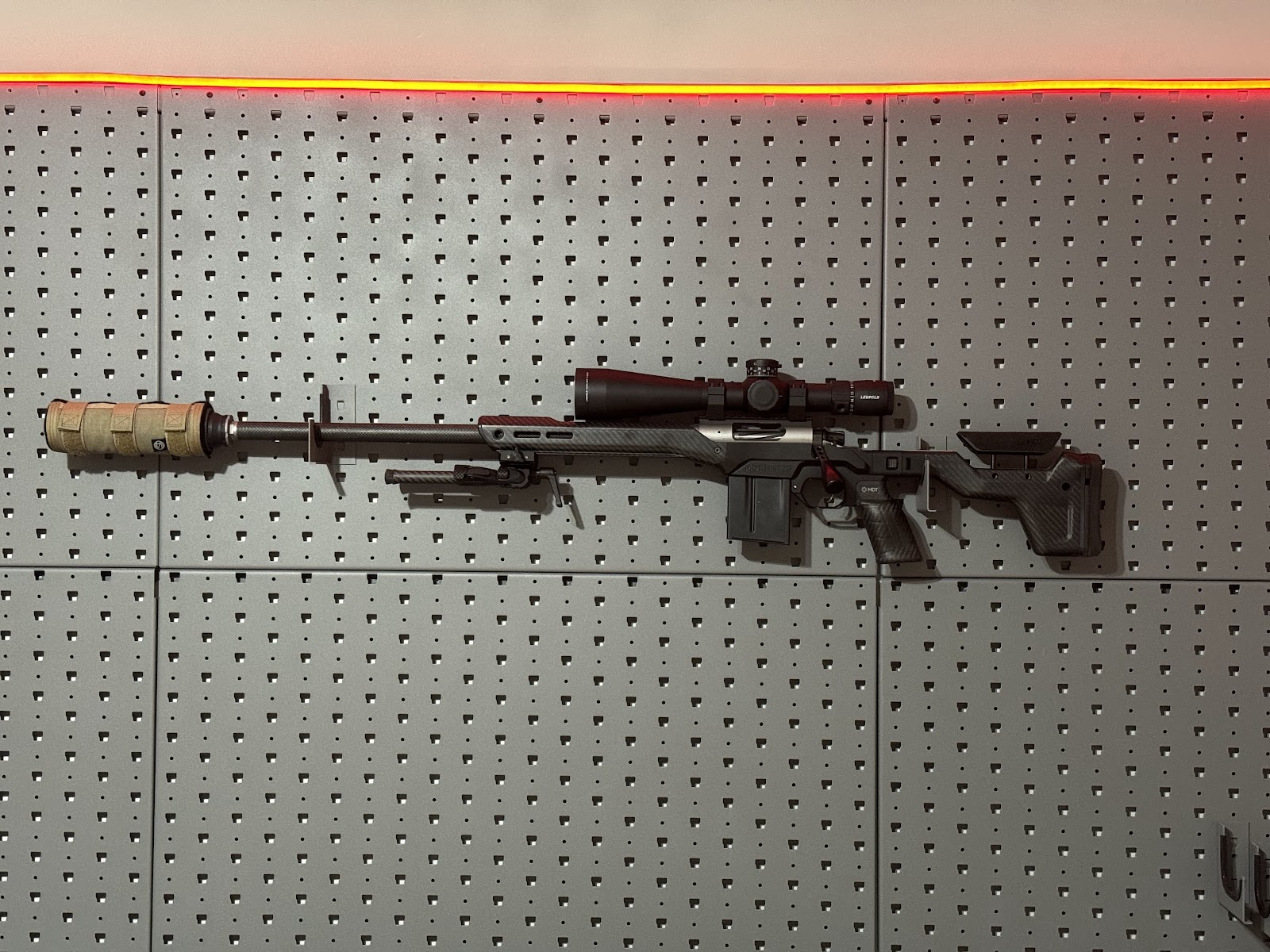
I immediately removed the barreled action from its factory stock. Why did that stock not cut the mustard? Most factory rifles do not come with an adjustable comb, which is necessary for the perfect sight picture and consistency. For sound suppression, I used the Dead Air Nomad 30 LTi. This suppressor is incredibly quiet and ridiculously light. For a chassis system I chose the MDT HNT26. The chassis is built from a magnesium alloy and carbon fiber, which makes the chassis ridiculously light, even with an adjustable cheek weld and side folding component. The folding stock allows the chassis to fit comfortably in my Eberlestock pack.
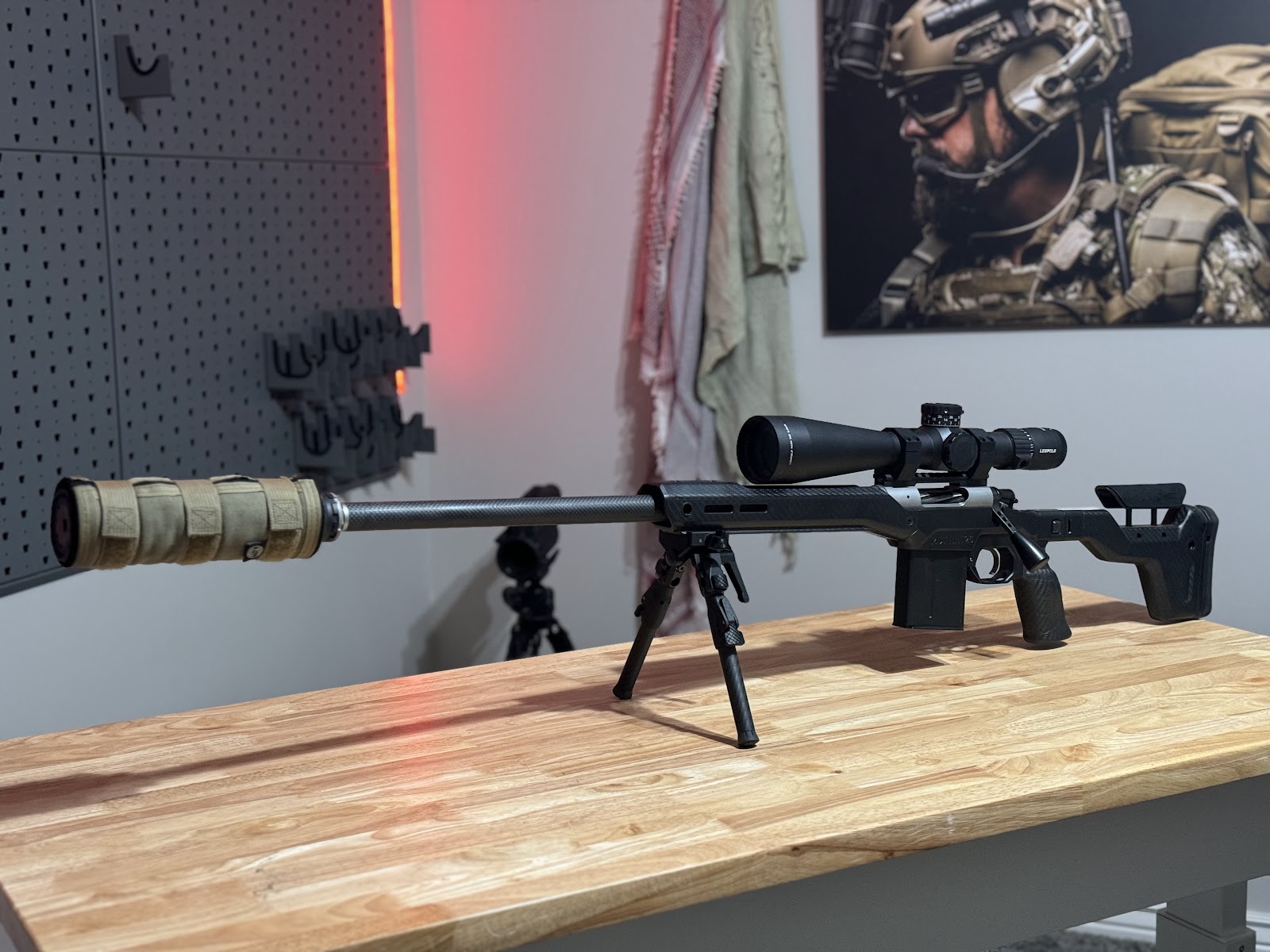
Next, I had to pick out a piece of glass, so I selected a Leupold Mark 5HD 5-25x56. Leupold is a leader in the optics industry with a strong pedigree, excellent glass quality, and perfect tracking. Now it's time to test. I took it to the range to establish a 100-yard zero and the rifle printed a ragged hole. Expecting the data to be very similar to my other 24-inch 6.5 PRC Rifles I took it to the 1000-yard paper range. I decided to only collect data to a maximum of 500 yards as I didn't feel it ethical to take such a large animal at any distance further. I printed a 1.25-inch group at 500 yards. This rifle, chassis, suppressor, and optic combination proved to be worthy.
THE HUNT
Spotting my trophy buffalo at 480 yards, having fresh and quite impressive data at the 500-yard line just a few days before, I felt confident at this distance that I could take down this trophy animal. Some very high winds were gusting at full value from left to right. This made me question the precision of the shot. So, I closed the distance again to 430 yards, where I felt confident about calling the winds and a stable position. Settling onto the rifle in the prone position. I knew the deal was done. As I locked my action, inputted my bullet drop data, and favored left by .25 MRAD for wind. I communicated to my spotter and pressed off a round. To my surprise, the animal did not move and did not flinch. I saw dust directly behind the animal. For a moment, I thought, "Did I miss?" And then I considered I must've pushed the bullet through both lungs, being little meat to stop the bullet from passing through. I ran the action and prepared for a follow-up shot. I held a tad lower as I knew a double lung could take time on such a large animal and pressed off a second shot. With a solid thump, the animal dropped to the ground with a heart shot.
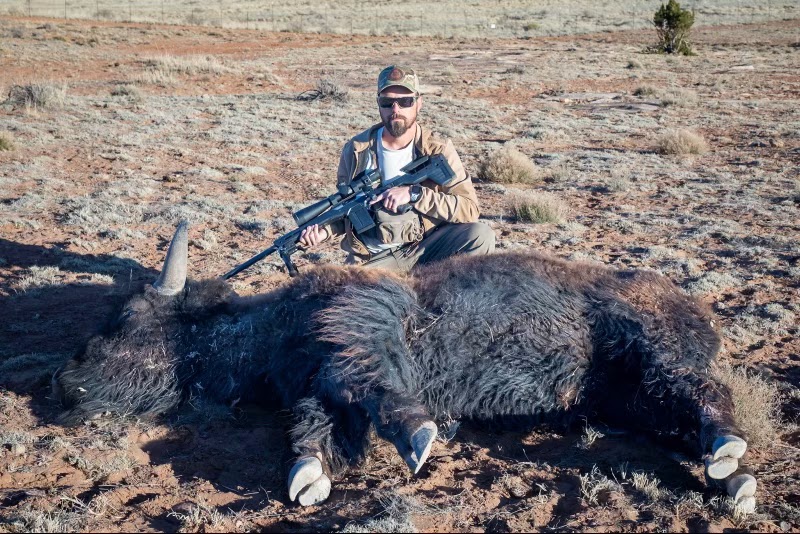
I stood up, took a breath, and glanced down range at the animal one more time as he got back up! Quickly mounting my rifle again, the animal began his drunken stumble of a walk. He then faced me on the narrow side. I aligned my crosshairs to his right eye, leaning back into the wind, and fired off another shot. A solid thump, brain shot. The animal did not react, he then broadsided me one more time where I aligned to his heart favored left by .2 mil and fired my fourth shot. This dropped him to the ground permanently. After the celebratory photos and high-fives, we processed the buffalo.
This incredibly tough animal had a double-long shot, two heart shots (one through each side), and a brain shot. Not how my hunts usually go. Historically, and in most of my hunts, my rifle will bark one time, and the animal will fall. Even at some far distances, I've had great success with my long-range abilities and quick decision-making while hunting. Not all hunts go that way. This proves as many other animals have proved to us, they might have a lack of willingness to comply with our request for them to die. This is why I put great stock in preparing for a follow-up shot as well as calling your impacts as a shooter. If you can see where the round strikes, you can rapidly adjust or give that animal additional lead as needed. This hunting story is still a success and came with challenges and rewards.
Check out the latest video on our YouTube channel!
More articles from Rob Orgel of Emergency Response Tactical
- Long-Range Hunting and Shot Placement
- Eye Dominance and Handedness Maximizing Speed and Efficiency
- Are You Ready for Your Hunt?
- Combat Readiness Regaining Mental Balance
- Bullet Expansion for Rifle Hunting
- Three Biggest Dangers During a Hunt
- Five Common Questions About NFA Items
ABOUT THE AUTHOR
Rob Orgel enlisted in the USMC in 2004 as an Infantry Rifleman (0311), serving with 3rd Bn 1st Marines in Iraq, including roles as a point man in OIF-3 & team leader in OIF-6. Later, he joined the 1st Marine Regiment, achieved the rank of Sergeant in 2010, & continued service in Afghanistan. Upon returning, he became a Combat Instructor at the School Of Infantry West. Transitioning to private military contracting with Securing Our Country (SOC), he instructed at the American Embassy in Iraq. In 2018, Rob became Chief Instructor at GPS Defense Sniper School, revamping their program. Now, as owner & lead instructor at Emergency Response Tactical, he focuses on training novice to advanced shooters on the range over 300 days a year.
EVERY SHOOTER IS VITAL: A NOTE TO THE RIFLE COMMUNITY
MDT Renegade Ultra-Light Shooting Bag Wins On Target Magazine's Editor's Choice Award
Related Posts

How Much Scope Magnification Do You Really Need for Hunting?

What Is An AICS Magazine?

3I-R: Visual Processing Behind the Rifle

Building the Ultimate Coyote Rifle: My 16-Inch .22 Creedmoor

Ultimate Reloader: 8.6 Blackout - Sub-Sonic Precision and Real World Testing

3 Military Skills That Made Me a Better Hunter

Muley Freak: Hunting Giant Bull Elk in Wyoming’s Backcountry


