

Inconsistent Shoulder Pressure and Accuracy - Inside MDT
Whenever shooters pick up a rifle and engage a target, one should try to be consistent and have sound fundamentals, thus ensuring the shot is delivered as perfectly as possible. However, the other day, I thought that I should occasionally try to do some part of the shot execution process incorrectly just to see what the effect would be.
As a result, on my next range outing, I determined to deliberately do something wrong, eventually settling on varying how tightly I pulled the buttstock into my shoulder when shooting. We all know consistency is key to shooting well, so I wondered what difference it would make if I fired a pair of 10-shot groups from a rifle, first with the butt pulled tight into my shoulder and then with the rifle butt barely contacting my shoulder. Would group size grow or shrink? Would the point of impact change? And would this have any effect on velocity?
After doing a rifle and ammo inventory, I settled on three rifles: a Ruger American in .22 LR and two custom rifles, one chambered for the .223 REM and the other for the 6.5 Creedmoor. Part of the reason for choosing these was that I had some leftover ammo for each that I could use up without dipping into my premium supply. In each case, the ammo wasn’t what the rifle shot best, but I judged it all to shoot well enough to draw valid conclusions.
All shooting was done from a benchrest on a day with temperatures just above the freezing mark and no significant wind. The centerfire rifles were allowed to cool after every five shots, which didn’t take long considering the temperature.
First up was the Ruger rimfire, with testing done at 50 yards using Winchester Subsonic Hollow Point ammo. Equipped with an MDT LSS chassis and a Bushnell scope, this is one of my go-to rifles for shooting varmints and pests.
The first 10-shot group with the butt pulled tightly into my shoulder measured 0.77 inches, but with minimal shoulder contact, ten shots spread out to 1.12 inches. Some horizontal stringing was evident in the latter group, although there was essentially no wind. There was a significant change in the point of impact as well. Velocities for all rifles were measured with a LabRadar LX chronograph, a compact device that made velocity measurements a breeze. And those velocities were close enough that I wouldn’t call them different, considering the sample size: A firm hold produced 1022 fps with an SD of 12. A loose hold yielded 1017 fps with an SD of 9.

Varying shoulder contact with a rimfire rifle changed group size and the point of impact.
Second was the 6.5 Creedmoor, and here I settled on 200 yards as the test distance, with the ammo consisting of handloads launching Hornady’s 130-grain ELD-M bullets. It’s an Ultimatum action with an RKS barrel and gain-twist rifling set into an MDT TIMBR chassis equipped with a Zeiss 3-15X scope.
A firm hold produced a 1.68-inch group, while a loose hold yielded one slightly smaller at 1.40-inch. Again, there was a significant change in the point of impact, about two inches worth. Velocities were again close, with firm shoulder contact producing 2827fps with an SD of 14 and a loose hold clocking in at 2821fps with an SD of 10.
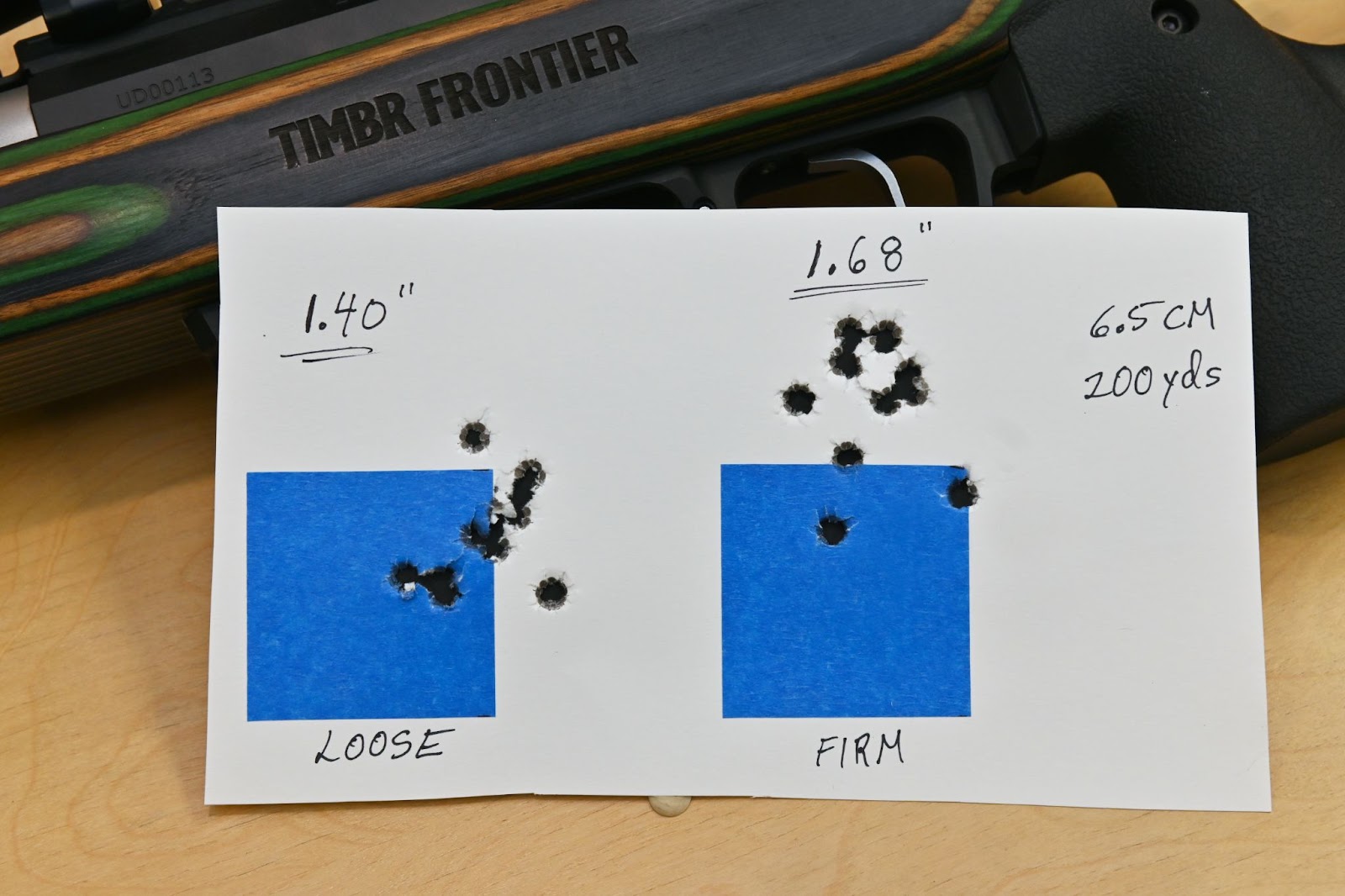
A 6.5 Creedmoor rifle also shifted the point of impact when shoulder contact changed.
Last up was the .223 REM, again tested at 200 yards. Here, I took the opportunity to use up some Norma 55-grain TIPSTRIKE ammo, which the rifle shoots fairly well. With a KS Arms action and a carbon fiber Proof barrel fitted into an MDT HNT-26 chassis, a Leupold 4.5-14X scope looks after sighting duties.
Like the others, I tried a firm hold first, which yielded a 10-shot 1.98-inch group. With the barrel cooled and with a much looser hold to the shoulder, the group size grew to 2.45 inches. Unlike the other two rifles, the point of impact stayed pretty much the same, which I found surprising. Velocities were similar, with the former yielding 3102fps with an SD of 10 and the latter producing 3113 fps with an SD of 11.
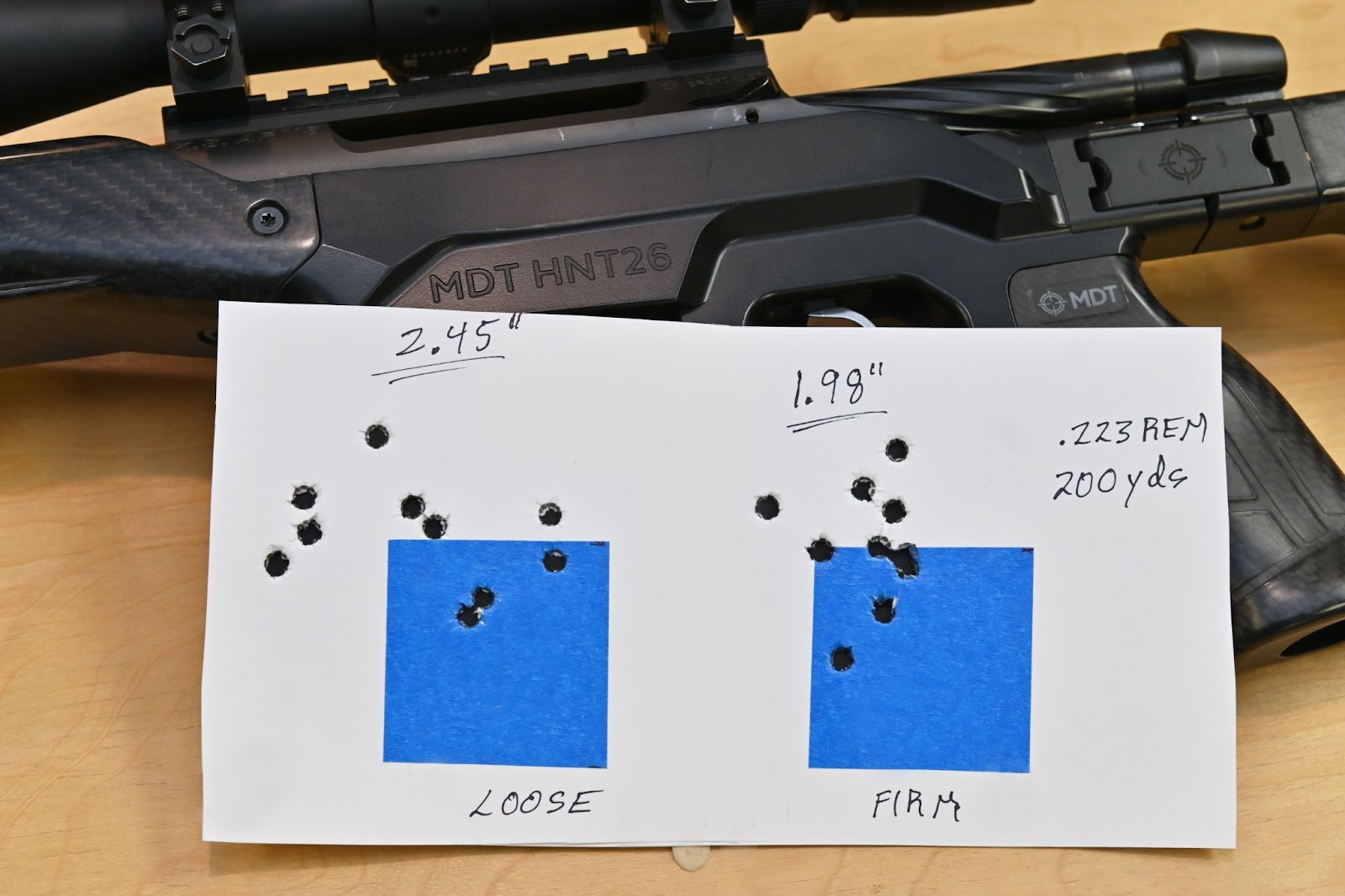
Changing shoulder contact with a .223 REM changed the group size, but the point of aim remained the same.
So, what does it all mean? All the rifles demonstrated either a change in precision or an altered point of impact when shoulder contact changed. Even considering the small sample sizes I’m dealing with here (only single ten-shot groups), I’ll suggest this humble effort at doing things wrong, which proved that consistent shoulder positioning and contact are needed for the best results. It proved a good reminder to check shoulder contact on every shot I take at the game this fall and winter, particularly the longer pokes I’ll likely be taking at Coyotes. In rifle shooting, consistency breeds success. I wonder what else I can learn by deliberately doing something wrong.
Check out the latest video on our YouTube channel!
ARTICLES FROM AL VOTH
- Common Shooting Myths
- Rimfire Season
- Optics: Parallax and Optical Center
- Optics: Understanding the Optical Triangle
- The Ethical Shot
- Avoid Common Gun Mistakes
- Hunting Drills for Success
- Pursuing Precision
- Rimfire Season
- Airgunning With MDT
- Picatinny Rails Vs Weaver Rails
- How to Keep Records on Your Firearms
EVERY SHOOTER IS VITAL: A NOTE TO THE RIFLE COMMUNITY
MDT Renegade Ultra-Light Shooting Bag Wins On Target Magazine's Editor's Choice Award
Related Posts

5 Reasons You’d Still Choose a .308 Today

Tactical Gear Guy: MDT LSS Gen3 Review

Loading a Bipod: Does It Help or Hurt Precision Rifle Accuracy?

Mission-Ready: The MDT ACC Premier Gen 2 for Modern SWAT Sniper Teams

Impact Precision: The 6mm Dasher “Sleeper” Rifle

Three Critical Handloading Measurements

5 Benefits of Suppressors Beyond Sound Reduction on Precision Rifles


